Schedule proofs for tags and labels
A tag proof is a table and a drawing: each legend beside its tag ID, with plate size, hole positions and material. Panel Tag Co issues it before engraving, so the technical team can verify the mapping while a correction costs one edited cell.
Explore the service process
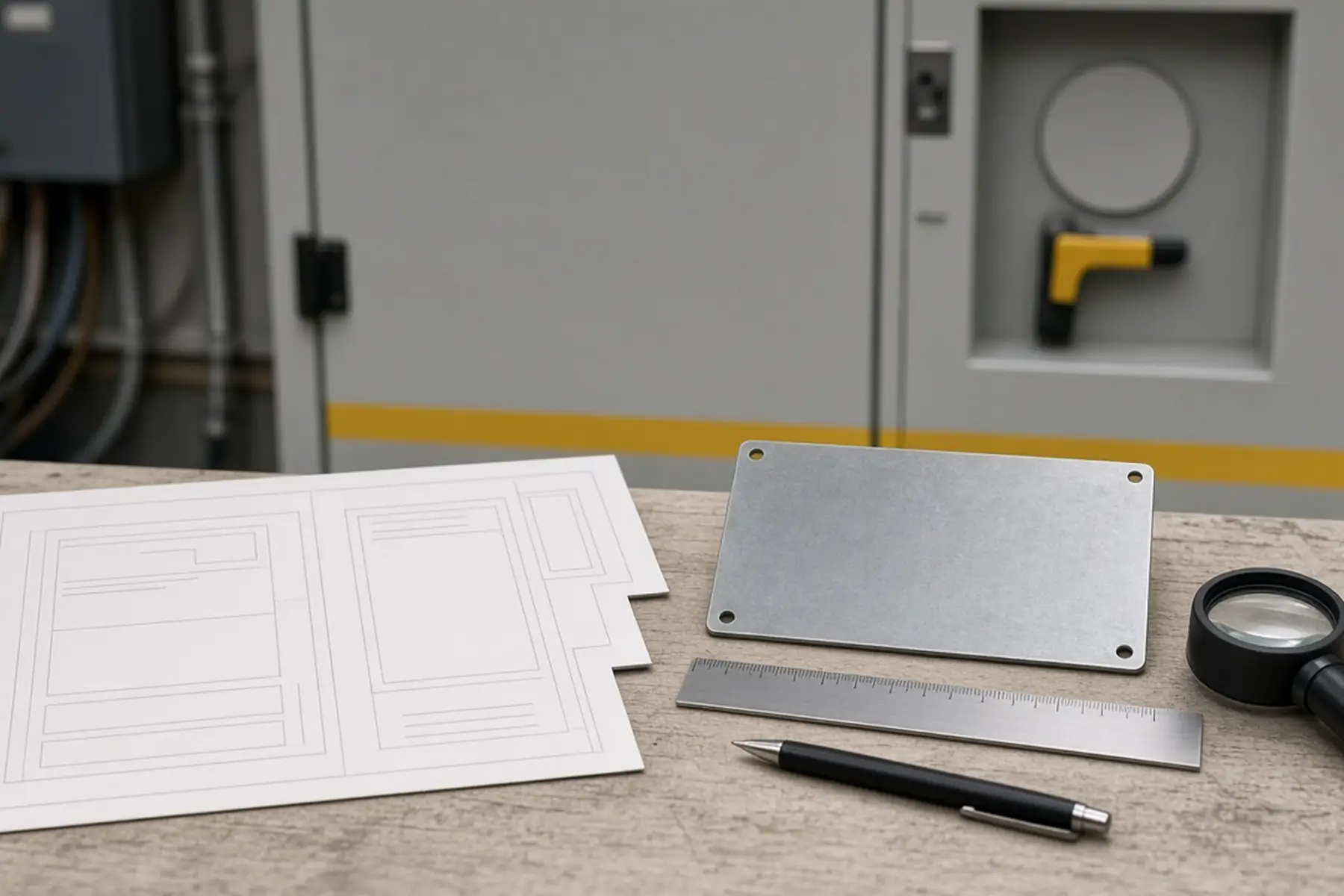
AI-generated process illustration. Equipment, materials and packaging shown are examples, not photographs of our workshop or completed orders.
What should an engineer verify on a tag proof?
Verify four things for every row: the identifier matches the current drawing, the legend reads exactly as approved, the size and hole pattern fit the mounting point, and the quantity is right. Panel Tag Co asks for a single marked-up reply per proof revision. The engineer responsible for the installation, not the buyer, should sign the mapping.
Which errors does a cabinet label proof expose?
A controls engineer is labeling cabinet CP-02. The Control Cabinet & PLC Labels schedule lists the cabinet, each device, its function and a drawing reference, E-204. On the proof she finds three problems. PLC-01 appears twice, because a row was copied and not edited. A power supply is labeled PS1 on the schedule but PS-1 on the drawing. And the label for the main controller is wider than the space above the rack, which she measured after the schedule was written. None of these is an engraving fault. All three would have been installed. She corrects the rows, attaches the drawing sheet and returns one marked-up file against revision R1.
An example from this collection
Control Cabinet & PLC Labels
Preserve punctuation and capitalization where they distinguish device names. Provide the final label schedule and available space, and have the responsible technical team verify the mapping before production.
The details to personalize: cabinet, device, function, drawing reference. The product page lets you enter them and carry the design into your quote request.
How should a tag proof be reviewed?
01
Open the current drawing revision
Check the revision on the drawing against the revision named on the proof. Reviewing a proof against an old sheet is how superseded device names get engraved.
02
Read identifiers character by character
Compare each ID with the drawing, watching O and 0, I and 1, hyphens and case. Tick the row only when every character agrees, then check the quantity beside it.
03
Test the fit on the cabinet
Take the proof dimensions to the door or backplate. Confirm clear space, hole positions and reading direction from where the operator stands, especially for switch legends.
Order terms in brief: Low minimums · production takes no more than 7 days, plus transit · rush available · worldwide shipping · 100% satisfaction refund. Full wording in the FAQ.
Questions about schedule proofs for tags and labels
What should an engineer verify on a tag proof?
Verify four things for every row: the identifier matches the current drawing, the legend reads exactly as approved, the size and hole pattern fit the mounting point, and the quantity is right. Panel Tag Co asks for a single marked-up reply per proof revision. The engineer responsible for the installation, not the buyer, should sign the mapping.
Does an approved proof mean the labels are technically correct?
No. Approval means the plates will match the proof. Whether the identifiers, functions and wiring references are right for the installation is verified by your technical team against its own drawings. Panel Tag Co reproduces the schedule and does not review the electrical or control design behind it.
How many proof revisions are part of a tag order?
The number of proof rounds and the proof format are set out in your written quote. Use them well by collecting comments from engineering, the installer and the client's representative first. One marked-up schedule against a named revision is far safer than corrections spread across several emails.
Can the proof show the finished color and surface of a tag?
It shows text, dimensions, hole positions and the material named in the quote. A screen cannot show the sheen of stainless or the exact shade of a laminate. If a face color has to match existing labels on site, say so and ask what physical reference can be provided.