Panel Tag Co · specification guide
Warning plates and ordinary asset identification compared
An ordinary asset plate identifies an object or reference. A warning plate communicates a hazard or a required precaution. They may use similar materials and fabrication processes, but their wording, design and approval requirements come from different decisions. Tell us which purpose your project requires before choosing a style or sending text for engraving.
Reviewed 2026-09-05 · AI-assisted editorial review. General buying guidance; illustrative scenarios are not customer case studies. Images are AI-generated concepts.
For an identification order, provide the authorized asset reference, physical specification and quantity. For a hazard-related order, provide the approved safety artwork or governing project specification and identify who is responsible for its review. A custom-fabrication quote can reproduce an approved design; it should not invent the hazard assessment or turn an attractive catalog layout into a claim of compliance.
Use the applicable specification for the actual workplace
OSHA 1910.145 addresses accident-prevention signs and tags, including classification, design and wording. It is a United States workplace standard, not a universal specification for every identification plate. Its presence in this guide explains why hazard communication needs its own review; it does not certify any proposed product or establish the rules for a particular job.
For a project elsewhere, ask the responsible workplace or design reviewer to identify the applicable requirements. Even within one organization, a routine inventory label and a hazard warning can follow different specifications. Record the project location and intended use so the review is based on the actual context, rather than a familiar signal word or color copied from an unrelated example.
If the purpose is uncertain, hold the wording decision and describe the function in the quote request. A short statement such as identify this cabinet in our maintenance register is different from communicate a specific hazard to people approaching the cabinet. The first may be resolved through an approved asset schedule; the second needs the responsible safety or engineering review.
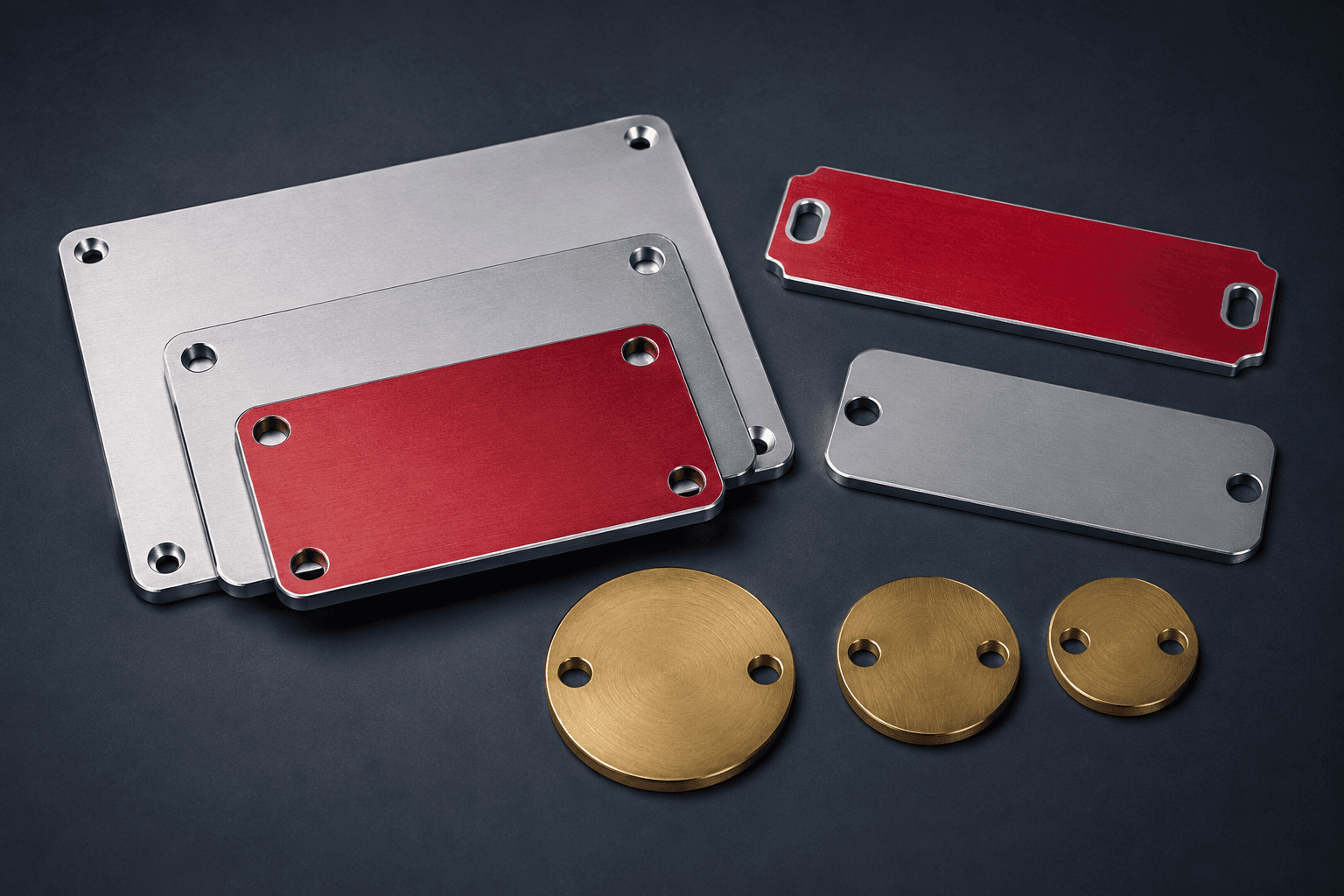

Define ordinary identification without adding instructions
An asset identifier can contain an approved equipment reference, ownership detail or other information chosen by the record owner. Keep the exact text and its relationship to the source register clear. The plate should not acquire an instruction merely because the buyer wants to fill empty space in a design.
A control legend can require its own equipment-specific approval even when it is short. Words that describe a function are not simply decorative labels. If the source schedule leaves a function uncertain, ask the responsible reviewer to resolve it. Do not infer control behavior from the name of a nearby asset or from a photograph supplied for material comparison.
When replacing an ordinary identification plate, confirm whether the underlying asset record has changed. Reproducing old text may be appropriate for a damaged plate, but an old sample is not automatically the current source. Keep the current approved legend and the reference photograph separate so the order makes clear which one governs the new inscription.
Preserve approved hazard artwork as a controlled design
For hazard communication, request the complete approved artwork or the exact specification from which it must be produced. That may include wording, symbols, color arrangement, dimensions and other project-specific requirements. Do not ask the production designer to choose a signal word based only on the available engraving space or your preferred visual style.
Keep translations and alternative layouts under the same review as the original. A shorter phrase that fits neatly may change the intended message. A decorative icon that resembles a familiar symbol may not be an acceptable replacement. If the supplied artwork cannot be produced as specified, identify the limitation and return the proposed change to the responsible reviewer before approval.
Retain the artwork revision and the person or role authorizing it in the order record. A message saying use the usual warning is insufficient when there are several versions or intended uses. The most useful handoff names the exact approved file and the locations or equipment groups for which it has been approved, without asking the supplier to make that determination.
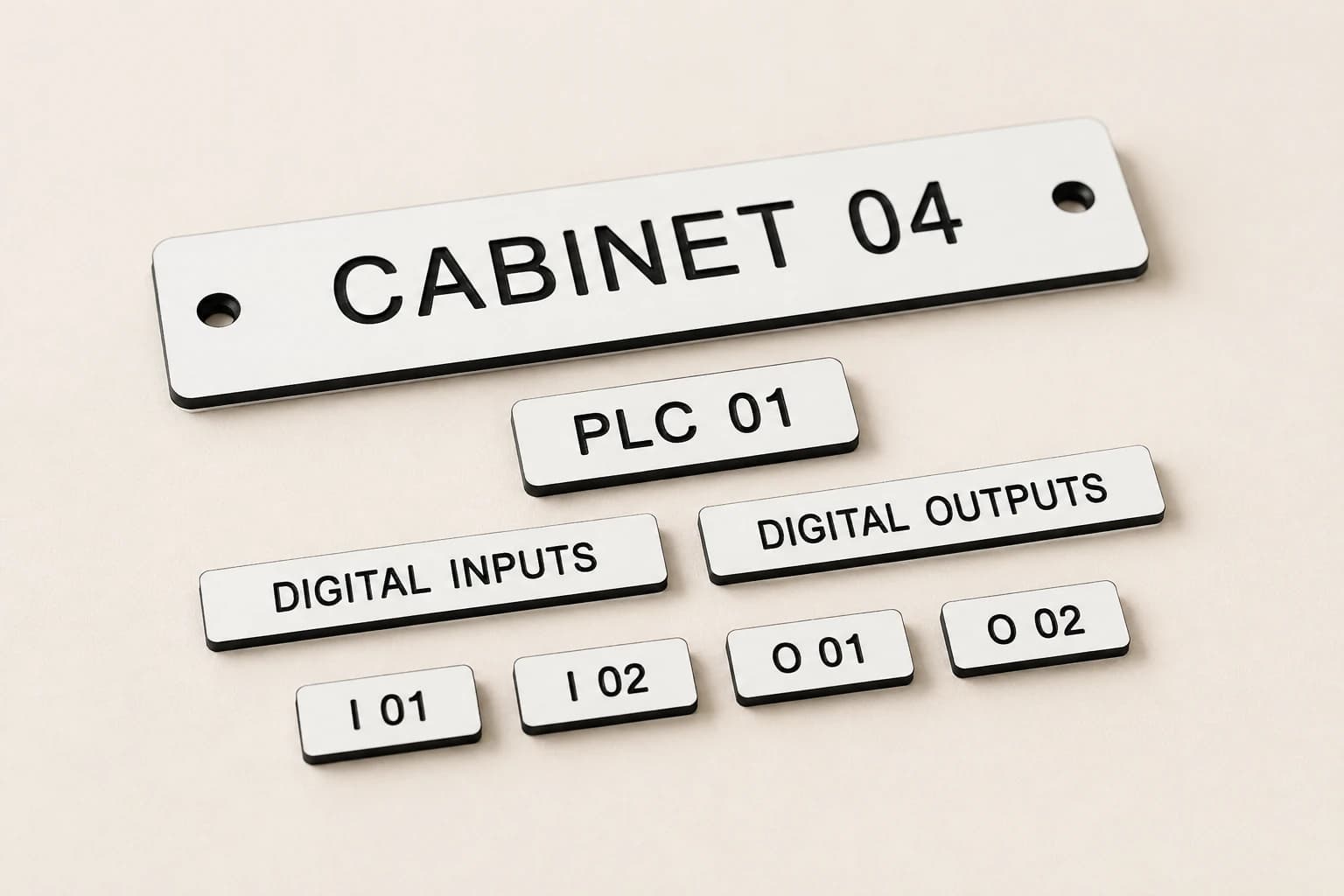
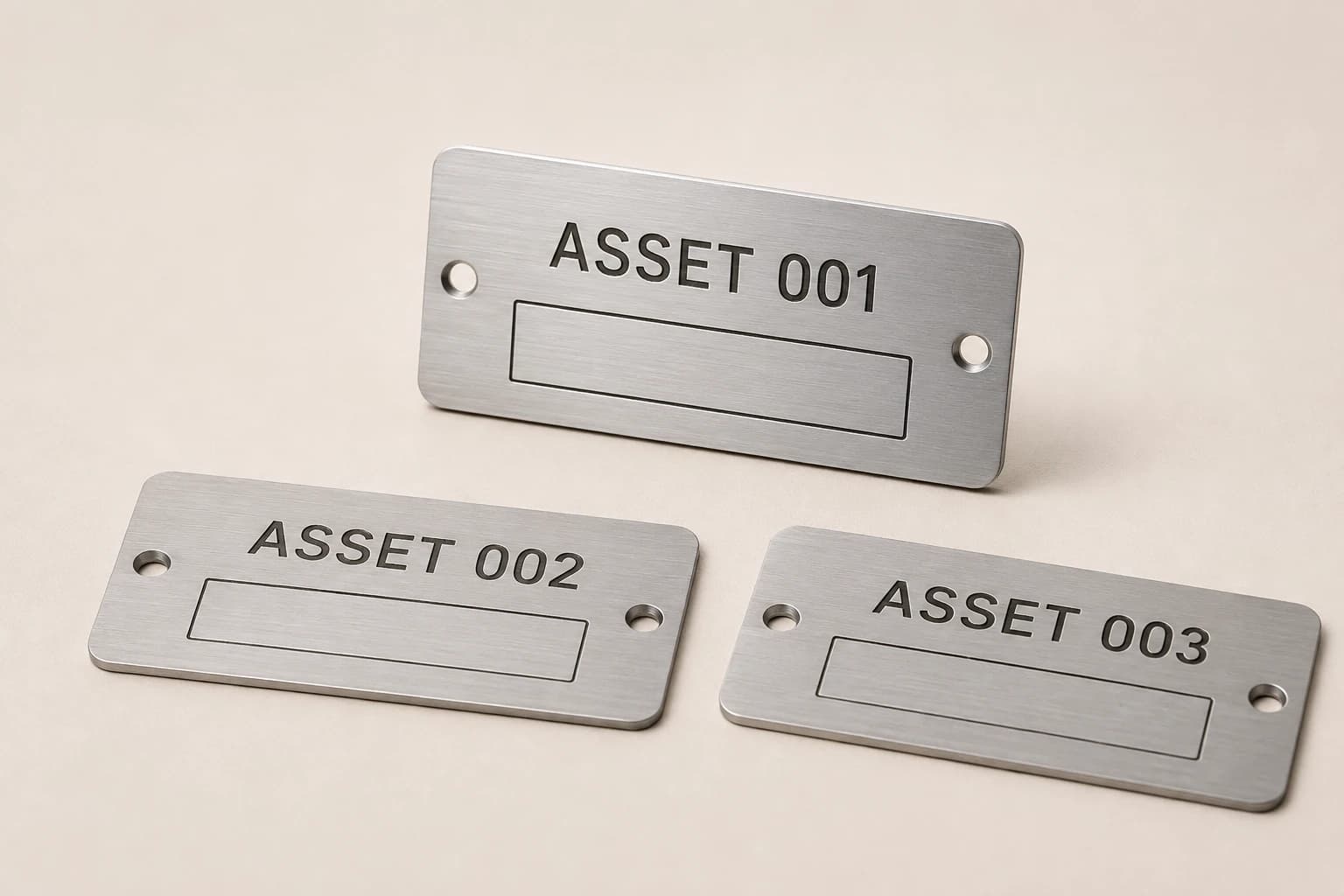
Illustrative example: two separate approval streams
Consider a fictional purchasing request for twelve ordinary asset plates and four hazard-related plates. The asset plates are described by an approved asset schedule, while the four hazard-related plates await a current artwork file from the responsible project reviewer. The planning quantity is sixteen pieces, but only the twelve asset plates have complete release information at this stage.
The calculator example adds 12 × 1 and 4 × 1 to show the sixteen requested physical pieces. That result is a planning total, not permission to manufacture all sixteen. The downloadable file deliberately lists two groups with different approval states and contains no suggested hazard wording. It demonstrates how to preserve the distinction without creating an apparently production-ready warning design.
Suppose the reviewer later supplies artwork revision W-03 for the four hazard-related plates. The purchasing team can then reference that exact file, confirm its physical specification and request a revised quote or release. The total stays sixteen if quantities remain unchanged. The approval state changes because the required information is now supplied, not because the arithmetic has been checked.
If the reviewer instead removes two hazard plates or changes their dimensions, update the order lines and quote before release. Do not leave the old count in a combined package price and assume the production team will reconcile it from the new artwork. Quantity, specification and approval state are separate fields that all need to agree.
Reconcile the physical pieces in this example
Load the illustrative article example, then replace each group and quantity with your approved order. Keep exact identifiers and specifications in the separate schedule.
Method: Multiply each row count by copies per group, then add only explicitly entered spares. This is an inventory calculation, not an engineering or compliance review.
Build your plan
Use one row per tag type. For example: Valve labels | 20 | 2. Material, dimensions, legend text and mounting belong in the final tag schedule.
Use the article’s example files
This is a fictional planning example. Import identifier columns as text and replace sample rows with authorized project data before requesting production.
Keep the intended use visible in the order
Choose the grouping that answers the purchasing question; keep the other references in the schedule.
| Option | What it counts or controls | What it does not establish |
|---|---|---|
| Asset identification | Exact approved identity and its link to the asset register. | A hazard assessment or instruction for operating the equipment. |
| Control or function legend | The wording approved for a specific function in the equipment documentation. | Permission to infer behavior from a generic product image. |
| Hazard communication | The authorized safety design for the stated project and use. | Compliance merely because a familiar color or signal word appears. |
| Replacement artwork | The precise revision selected for reproduction or approved modification. | That an old installed sample remains current. |
| Purchasing quantity | How many physical objects are requested in each group. | Release approval for a group with unresolved wording or design. |
Treat durability as a specification question
Describe the actual exposure and handling conditions for the plate, including the surface and mounting arrangement proposed by the project. Ask production to confirm a suitable material and marking process against those requirements. A material name alone does not establish how every finish, adhesive or printed layer will perform in the intended environment.
For a hazard-related plate, have the responsible reviewer confirm any required performance or identification standard before selecting a substitute. A proposal to use a different material can affect more than appearance. Record the proposed change and its acceptance rather than treating a visually similar sample as equivalent evidence.
For ordinary identifiers, the same clarity improves the order even when the approval process is simpler. State the dimensions, desired marking contrast and any requirement to match an existing system. Use actual samples or drawings when available. Concept images help describe a design direction, but they do not supply a verified service life, certification or installation result.
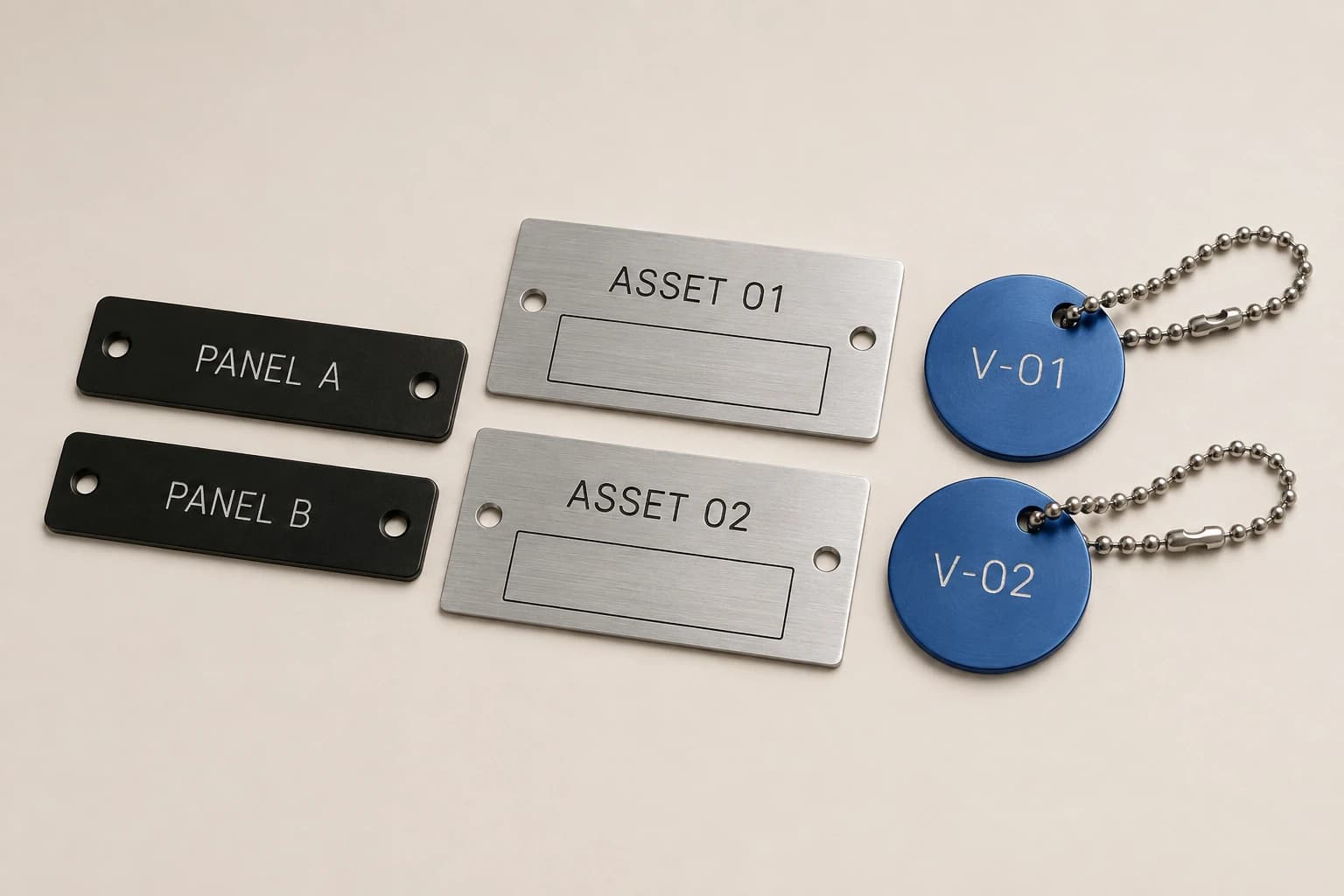
Check the proof against the right source
Review the asset group against its approved identifier schedule, including punctuation and any fixed prefixes. Review hazard-related artwork against its authorized file and project specification. A combined proof package can contain both groups, but the reviewer should be able to see which source governs each one.
If the proofing process reveals a wording error in the supplied source, correct that source through its owner and issue a new revision. Do not silently fix the visible proof while leaving an older file available for the reorder. The final production artwork and retained source should describe the same approved message.
Make quantities and format references visible beside the proof entries. Approval of the text does not automatically approve a material substitution or a different size. Conversely, accepting a material sample does not confirm the wording. A short release record identifying the files and the accepted scope helps keep those decisions from being blurred together.
Pack and reorder according to the approved purpose
Where a project mixes asset identifiers and hazard-related plates, keep the groups identifiable in the packing request. Use order-line and artwork references rather than an informal description such as the red ones. Color may be useful as a visual cue, but it should not carry the entire allocation when several designs share it.
A receiving discrepancy should identify the affected line, expected revision and quantity. Do not issue a substitute plate solely because it has the same dimensions. Resolve whether the correct approved design was supplied, then arrange any correction through the order record. Installation and workplace decisions remain with the responsible team.
For reorders, confirm whether the original design remains authorized for the new application. A file that was appropriate for one equipment group or earlier project should not be copied into a different use without review. Keeping purpose, source revision and intended allocation with the artwork makes a repeat order more specific and reduces reliance on memory.
Questions before ordering
Can you create warning wording from a photo?
A photo can help identify the item being discussed, but the responsible project reviewer should provide or approve the actual hazard message and design. Submit the current specification or approved artwork for quoting and reproduction.
Is a warning-colored asset plate a compliant safety sign?
Appearance alone does not establish that. Intended use, applicable requirements, approved design and the actual installation context need their own review. Do not treat a catalog color choice as certification.
Can ordinary and hazard-related plates share one order?
Yes, a quote can contain separate groups with their own sources, specifications, quantities and approval states. Keep unresolved hazard artwork on hold rather than letting a combined total imply every line is ready.
Will you choose the rules for an overseas project?
Provide the requirements identified by your responsible local or project reviewer. This buying guide does not select a jurisdiction’s rules or certify the final installation. The production proposal should refer to the supplied approved specification.
Explore the collection’s design direction
This existing narrated collection overview introduces the product designs. It provides visual background; the specific decision, comparison and worked example are in the article above. Images are original concepts rather than completed customer orders.
25-second overview
Define the installation
Before changing a tag material, identify what cannot change: the legend, mounting pattern, exposure and project requirements. Compare complete options, preserve identifiers in a controlled file, and review the longest text at the proposed size. Keep the approved drawing with the order record. Use the tag calculator to prepare quantities for your quote.
Prepare your brief and request a written quote.
Bring this decision into your design brief
Choose a relevant product direction and include the measurements, quantity, approved wording and delivery destination for your project. We can then develop a specific design and quote around those requirements.
Sources and scope
The sources below support the cited technical details. The ordering workflows are editorial recommendations. Your project specification, price and schedule are established in the written quote and approved proof.
Which buying guide should you read next?
All buying guidesCompares two published facility electrical identification specifications side by side to show that nameplate colors differ by owner, then lists exactly what to send so engraved tags match your own specification. Panel Tag Co engraves to the specification you supply and makes no code-compliance claim.
Protect the exact identifier through spreadsheet import, export, proof and packing while separating engraving text from quantities and refusing to reconstruct lost digits without an authoritative schedule.
Count unique legends, physical copies and installation kits separately. Preserve identifiers as text and attach the approved drawing revision, dimensions and mounting detail to each group. Split the packing schedule by panel or site without changing the source identifiers.
A replacement plate needs a complete mounting pattern as well as its outside dimensions. Preserve the original units, hole references and approved drawing.